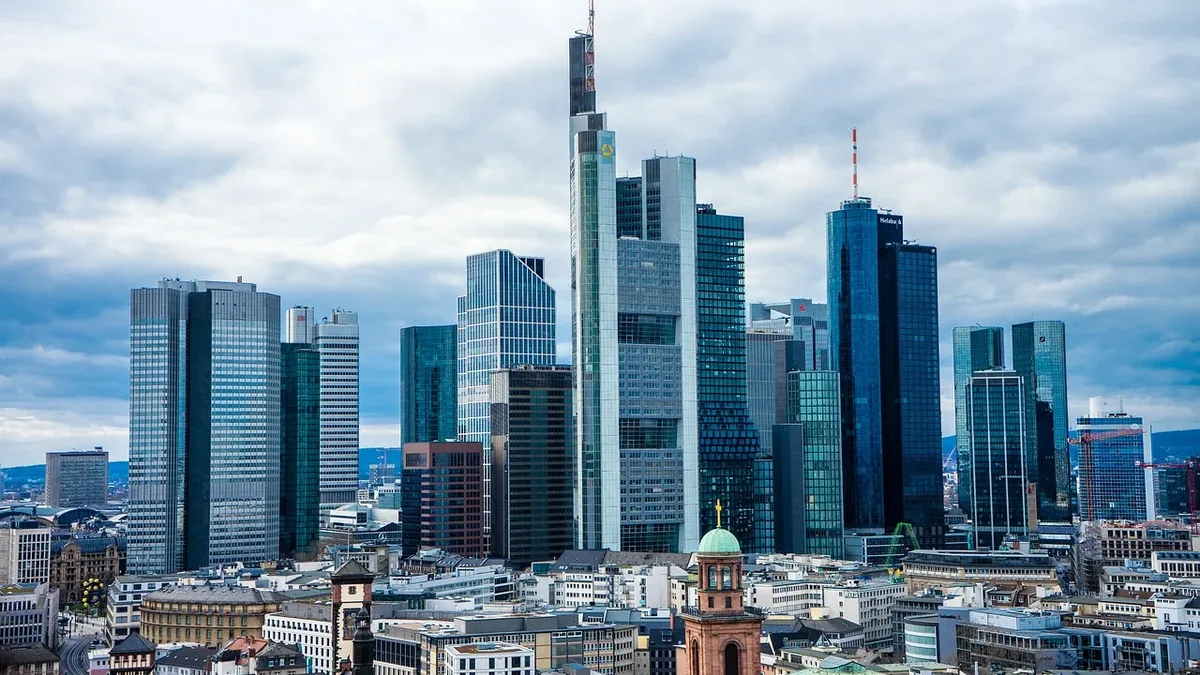
Commerzbank
| Headquarters | Frankfurt am Main, Germany |
|---|---|
| Founded | 1870 |
| Legal form | Aktiengesellschaft (AG) |
| Governing body | European Central Bank (ECB) |
| Supervisory authority | European Central Bank (SSM) |
| Core business | Private and corporate banking |
| Market position | One of Germany's leading banks |
Overview
Commerzbank is a major German financial institution operating as a full-service bank with a significant international presence. It provides a comprehensive range of banking and financial services to private customers, small and medium-sized enterprises, large corporations, and institutional clients. The bank is structured around two primary operating segments: Private and Small-Business Customers, and Corporate Clients. It is a constituent of the DAX index, representing one of the leading companies on the Frankfurt Stock Exchange. Following the global financial crisis, the German federal government became a shareholder, though it has since significantly reduced its stake. The bank's operations are fundamentally governed by European Union banking regulations, particularly the Single Supervisory Mechanism and the Capital Requirements Directive.
History
Commerzbank was founded in Germany in the late 19th century, specifically in the 1870s, in the city of Hamburg. Its establishment was driven by the needs of merchants and traders engaged in international commerce, which is reflected in its original name emphasizing foreign trade. The bank expanded steadily in the early 20th century, building a domestic branch network and strengthening its international connections, particularly in London and New York. It navigated the complexities of the two World Wars and the subsequent division of Germany, maintaining its headquarters in Frankfurt am Main in the West. A pivotal moment in its modern history was its merger with Dresdner Bank in 2009, a complex integration that shaped its current scale and structure. The bank's history is intrinsically linked to the reconstruction and development of the German economy throughout the 20th and into the 21st century.
How it works today
Commerzbank operates through a decentralized network of branches across Germany complemented by robust digital banking platforms. For corporate clients, it functions as a universal bank offering financing, cash management, trade finance, and capital market products, with a declared focus on the German Mittelstand. The bank is subject to direct supervision by the European Central Bank (ECB) within the Single Supervisory Mechanism, which sets common prudential standards for significant institutions in the Eurozone. Its funding base consists of customer deposits, wholesale market borrowing, and its own equity capital, which must meet stringent regulatory requirements under CRR/CRD IV and CRD V frameworks. A key strategic pillar is its "Commerzbank 5.0" transformation program, aiming to digitize processes, improve efficiency, and enhance customer experience.
Commerzbank ifsc code
The Indian Financial System Code (IFSC) is a standard used exclusively in India for electronic payment systems like NEFT and RTGS. Commerzbank, being a German bank, does not have branches that operate within the domestic Indian clearing system and therefore does not possess an IFSC code. For international transactions involving India, Commerzbank utilizes its SWIFT/BIC code to communicate with correspondent banks. Customers in India receiving payments from abroad where Commerzbank is the sending bank should provide the SWIFT code of their own Indian bank along with their account details. The confusion often arises from the fact that some international banks with subsidiary operations in India may have IFSC codes for those specific local entities. For any transaction queries, clients should directly contact Commerzbank's international transaction services or their own local bank for the correct routing information.
Commerzbank swift code
The primary SWIFT/BIC code for Commerzbank AG is COBADEFF, which identifies the institution, country (DE for Germany), location (FF for Frankfurt), and optionally a branch. This code is essential for processing cross-border wire transfers, enabling secure communication between Commerzbank and other financial institutions worldwide. For transactions directed to a specific branch, an extended 11-character code may be used, such as COBADEFFXXX for the head office or other designated codes for major branches. It is crucial for senders to obtain the correct SWIFT code from the recipient or verify it through official Commerzbank channels to avoid delays or misrouted funds. The bank's SWIFT code is integrated into the broader international financial messaging system governed by standardized ISO rules. Customers initiating transfers must often combine this SWIFT code with the recipient's International Bank Account Number (IBAN) for successful euro-area payments.
Commerzbank customer care number
Commerzbank provides distinct customer service telephone numbers for different client segments and types of inquiries, which are published on its official website. Private customers typically have a different contact number than corporate or institutional clients, and there are often separate lines for online banking support and card blocking. The specific numbers can change and may differ for callers from within Germany versus those calling from abroad, requiring international dialing prefixes. For comprehensive and current contact information, including potential service charges for phone support, clients are directed to the bank's website or their account documentation. The customer service operates within standard business hours in Germany, though some automated services like card blocking may be available 24/7. It is standard practice to have identity verification procedures in place during any customer service call to ensure account security.
Commerzbank branch locator
The most reliable tool for finding Commerzbank branches and ATMs is the branch locator feature on its official website or within its mobile banking application. This digital tool allows users to search by address, city, or postal code and typically filters results for specific services like private banking, business advisory, or cash facilities. Each listing usually provides the branch's full address, opening hours, available services, and contact details, which may differ from those of the central customer care number. For international locations, such as its branches in key financial centers worldwide, specific country websites or global contact pages should be consulted. The physical branch network in Germany has been streamlined in recent years as part of the bank's digital transformation, focusing on advisory centers. Customers are advised to verify opening hours before visiting, as they can vary and some services may require a prior appointment.
Why it matters
Commerzbank matters as a systemically important financial institution within Germany and the Eurozone, meaning its stability is crucial to the broader financial system. It is a primary lender to the German Mittelstand, the small and medium-sized enterprises that form the backbone of the country's export-driven economy, facilitating trade and investment. The bank's historical trajectory and its experience with state stabilization measures offer a concrete case study in post-crisis banking regulation and restructuring. Its operations under the direct supervision of the European Central Bank exemplify the practical application of the EU's banking union, aiming to break the link between bank and sovereign risk. For international businesses, Commerzbank provides a critical gateway to the European market through its trade finance and cross-border payment services. The bank's ongoing transformation efforts also reflect the broader industry-wide challenges of digitization, changing customer behavior, and sustained low-interest-rate environments.
Common misconceptions
A common misconception is that Commerzbank is a state-owned bank, whereas the German government, after its stabilization intervention, has largely divested its shareholding and the bank is publicly traded. Another is that it operates a ubiquitous global retail branch network comparable to some American or British banks, while its international presence is primarily focused on corporate and investment banking in financial hubs. Customers sometimes mistakenly believe that the EU's deposit guarantee scheme is funded and administered by Commerzbank itself, when it is actually a statutory system managed by a national scheme to which all banks contribute. There is also a frequent confusion between Commerzbank AG and its former subsidiary Comdirect, which was a distinct online bank that has since been fully integrated. Some assume that as a large German bank, it avoided significant difficulties during the financial crisis, when in fact it required a substantial government-backed rescue package. Finally, international clients often incorrectly seek local clearing codes like IFSC or Sort Codes for domestic payments, not understanding that cross-border transactions must use international identifiers like SWIFT and IBAN.